Behavior and Ecology
of four primates in
the Bwindi
Impenetrable Forest
Uganda.
Joanna Z.
Greenfield, BSc
thesis 1988 |
|
Joanna Z. Greenfield,
BSc thesis 1988.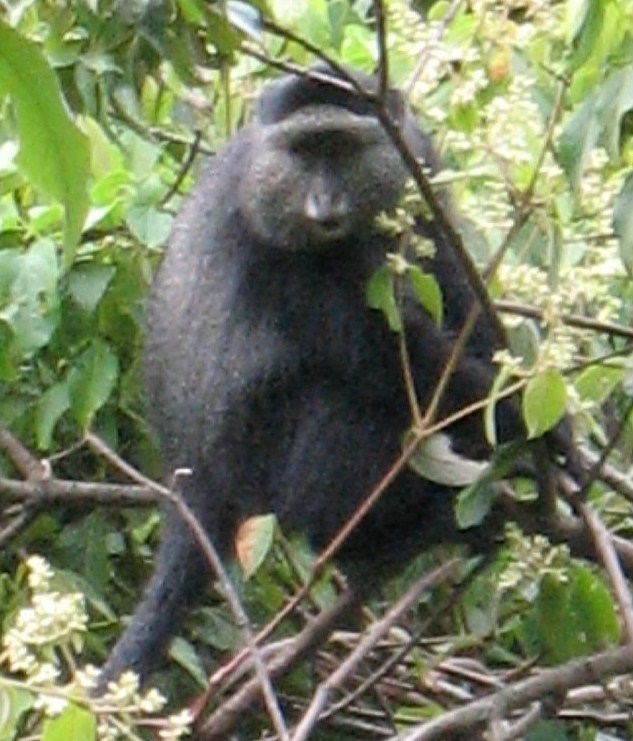
The aim of
this study was to examine the interrelations and interactions of four
primate species, Cercopithecus ascanius (Red tail monkey),
Cercopithecus mitis (Blue monkey), Cercopithecus l’ Hoesti
(I’ Hoest's monkey), and Pan troglodytes (Chimpanzee) in
the Bwindi Impenetrable Forest in Uganda. These relationships were
analyzed using niche separation and overlap in vertical foraging, food
species, and interspecific behavioural interactions.
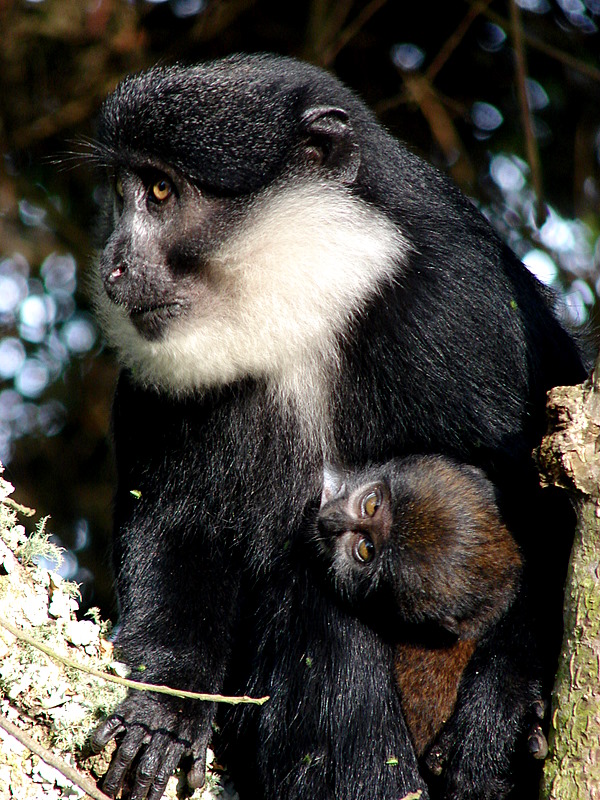
Foraging heights were recorded to reveal the pattern of vertical niche
differentiation. Food eaten was also recorded so that a comparison
of food preferences could be made. Additional information on
interspecific dominance and poly-specific associations was
recorded opportunistically.
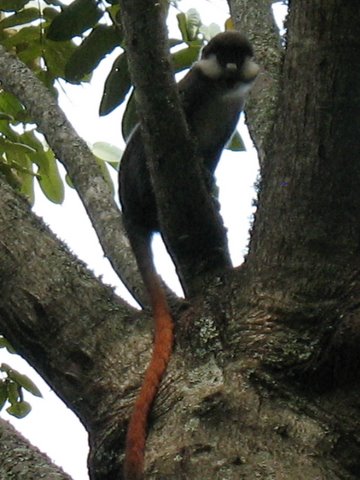
The
results showed C. ascanius and C. mitis have the highest
degree of overlap, and P. troglodytes overlaps with the other
three species. C. ascanius foraged over all heights of the forest
but focused slightly more on the lower middle layer, C. mitis
foraged mostly around the higher middle layer. P. troglodytes
used the three different layers of the forest and C. l’ Hoesti
was found to forage mostly in the lowest layer and on the
ground. The close foraging of these primate species next to each other
may reduce predation. Results suggest competition among the four
primates especially over Ficus capensis fruits. There is
an interspecific dominance hierarchy with P. troglodytes > C.
mitis > C. l’ Hoesti > C. ascanius. This agrees with
results from Kibale Forest. |



