|
The
Institute of Tropical Forest
Conservation
dates as far back as 1983
with an ecological survey of
Bwindi by Dr.
Thomas M. Butynski, funded
by the New York Zoological
Society (now Wildlife
Conservation Society).
Butynski’s findings sparked
the interest of the
Worldwide Fund for Nature (WWF)
to promote the conservation
of Mountain gorillas from
their habitat in SW
Uganda.
|
"As
the WWF Regional
Representative
at the time that
ITFC was
established, I
worked very
closely with
Professor
Kayanja,
Tom Butynski
and Jonathan
Baranga to
develop the
documentation
and
institutional
arrangements to
make ITFC a
sustainable part
of Uganda's
conservation
landscape.
It is
very satisfying
to see that,
despite all of
the challenges
we faced at the
beginning, ITFC
is thriving and
making the
contribution to
tropical forest
conservation
that we
envisioned...
"Ed Wilson.
More stories from ITFC's past... |
In 1986, the Impenetrable
Forest Conservation Project
(IFCP) begun, with support from WWF. The project's
mission was to protect last
remaining Afro-montane
forests of south-west
Uganda; Bwindi, Mgahinga and
Echuya.
The following year IFCP
entered a
long-term partnership
collaborations with CARE to
develop the Development
Through Conservation Project,
providing benefits to local
communities. At the same
time, influential people
like Professor Frederick
Kayanja (Vice Chancellor of Mbarara
University) and Dr. Erick
Edroma put pressure on
the Government of Uganda to
improve the conservation
status of several of the
countries Forest Reserves.
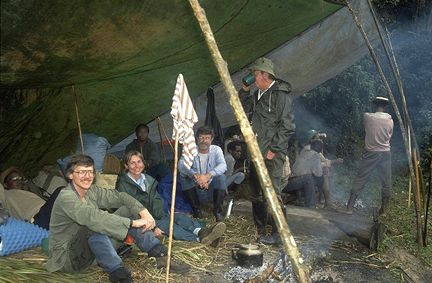
F.l.t.r. Tom Butynski, Jan
Kalina, John Miskell, John
Ashe (1990,
courtesy Bob Drewes)
In August 1991, the
Impenetrable Forest and
Mgahinga Forest Reserves
were re-gazetted as Bwindi
Impenetrable National Park
and Mgahinga Gorilla
National Park.
In the same year, the
Institute of Topical Forest
Conservation (ITFC) was
established, to ensure the
continuation of the IFCP’s
conservation, research and
training activities. ITFC is
a research institute under
Mbarara University of
Science and Technology
(MUST).
Our mission is to support and undertake research, monitoring and capacity development; to bolster conservation understanding and practice in the region.
ITFC has developed
significantly in terms of
infrastructure and human
resource.
The institute has a well
equipped office, a
specialist library, small
herbarium and basic
laboratory, a ‘conservation
education centre’ and
accommodation for its staff
as well as for up to 40
visitors (students,
trainees, researchers).
Solar panels and a back-up
generator ensure permanent
power supply and a satellite
internet link ensures
communication and access to
information. |